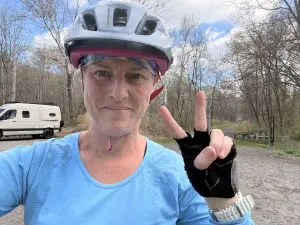
Turning 8: A Brain Injury Birthday

I had to relearn how to talk, walk, and see after a near-fatal brain injury.
Eight years later, I’m celebrating my other birthday — and it looks a lot like being 8 years old again.
A wise psychologist once described recovering from a brain injury as a developmental journey — newborn, toddler, tween, teen, and beyond. It stuck with me, because that’s exactly what happened. I flatlined the day of my near-fatal brain injury. Then I had to learn everything again: how to talk, how to listen, how to see, how to walk. The cognitive growth never stopped — it still hasn’t.
There isn’t much I can do to relearn smell or taste. Those doors closed. But the rest of me? Determined. If you’re not green, you’re not growing.
So today is my 8th birthday.
Not the birthday my driver’s license remembers — the one my brain remembers. Eight years since I flatlined and started over from zero.
I’m also, technically, middle-aged. In the middle of my recovery. A middle child. Deep in a midlife crisis. It’s almost funny how many “middles” show up when your whole life becomes a rebuild.
So I asked: what are the characteristics of an eight-year-old?
Turns out, developmental psychologists call this stage “middle childhood” — and it’s strikingly specific. Here’s what shows up for a typical eight-year-old (according to my good friend, Claude), stacked against what shows up for an eight-year brain injury survivor (according to me, living it):
Eight-Year-Old |
TBI Eight Year Survivor |
Cognitive & Thinking |
|
Concrete logical thinking develops (Piaget’s “concrete operational” stage) — they can reason about cause and effect, classify objects, understand conservation. |
Some logical thinking, unless brain exhaustion or a trigger arises. |
Growing attention span, though still limited to 20-30 minutes of sustained focus. |
Attention span is 45-60 minutes on a good day; sometimes it’s minutes. Oh look, a squirrel. |
Increasing interest in rules, fairness, and “how things work”. |
Continually questions rules and fairness and the why behind things. |
Better memory and ability to plan, though still developing. |
Better memory and ability to plan, though still developing. |
Social & Emotional |
|
Friendships become more important and more selective; best friends and small groups matter a lot. |
Loss of some friendships, true meaningful ones stick. Addition of new connections. |
Strong sense of fairness and justice — “that’s not fair!” is common. |
ADAAA- accessibility and inclusion are of high importance. |
Beginning to compare themselves to peers, which can affect self-esteem. |
Start not to care how I compare to others; accepting that I’m different than who I was before and that there is no such thing as normal. |
Can still have big emotional reactions, but better at naming and regulating feelings than younger kids. |
Better with emotional regulation and knowing when and how to create space. |
Sensitive to criticism and eager for approval from adults and peers alike. |
Sensitive to criticism and negative feedback; need for validation. |
Behavioral Patterns |
|
More independence-seeking — wanting to do things “myself” and sometimes pushing back on parental authority. |
Fairly independent yet learning to be accepting of when I need support. |
Testing boundaries and negotiating rules. |
Pushing boundaries. |
Increased responsibility-taking (chores, homework, caring for pets) |
Increased independence. |
Competitive streak often emerges, especially around games and sports. |
Competitive streak when trying to prove to myself and others that I (still) can. |
Can be prone to tattling as they work out social rules. |
Blaming others when events go sideways. |
Humor becomes more sophisticated — jokes, wordplay, sarcasm start to land. |
Self-regulation and filters are more present. |
Physical |
|
Steady growth (less rapid than toddler years). |
Physical abilities development has reached its max. |
Improved coordination and motor skills — better at sports, writing, fine motor tasks. |
Physical abilities recovered except when over stimulated. |
Generally high energy levels. |
High energy but need to not push beyond certain levels of exertion; the spoon theory. |
I’ve bolded the ones that are identical, italicized those that are different, and left in regular font the things that are the similar. Interesting, isn’t it?
If you’re not green, you’re not growing.
And eight years in, I’m still growing.
I don’t know what nine will look like. But I know I’ll be here to find out.