

Has the title caught your attention? Have you questioned yourself recently? Ever felt like you don’t belong? Is this a real thing? Read on.
Impostor syndrome has come up again and again in my coaching sessions over the past few months. An estimated 70% of people experience impostor feelings at some point in their lives, according to a review article published in the International Journal of Behavioral Science.
What Is It?
Let’s start with a shared definition. Impostor syndrome is a psychological pattern in which people doubt their accomplishments and live with a persistent fear of being exposed as a fraud, despite clear evidence of their competence. According to psychologist Audrey Ervin, it can apply to anyone “who isn’t able to internalize and own their successes.”
How Does it Show Up?
Self-doubt: Questioning your intelligence, skills, or readiness even after succeeding.
Attributing success to luck: Believing your achievements came down to good timing or a mistake rather than hard work or talent.
Perfectionism: Setting impossible standards and feeling like a failure if you don’t perform at 100%.
Over-preparing: Working excessively hard so nobody discovers your perceived shortcomings.
Why Is This Coming Up?
I’m not a psychologist, but I’m always trying to understand what’s behind what I hear. Here are some of my theories:
– Career stage: Early in a career: “Why would anyone want to listen to me?” “Did I get promoted too soon?” Late in a career: “I’ve been doing this too long. I’m competing with people who are much younger and have more energy.” “Why wasn’t I promoted sooner?”
– Entrepreneurship: “Why would people spend their hard-earned money on the service or product I’m offering?”
– The state of the world: So much feels off-kilter right now. Many of us are asking, “What’s this all for?” or “What’s my purpose?” Self-doubt tends to creep in alongside those questions.
– Upbringing: Critical childhood expectations or outside pressure to reach a certain level or status.
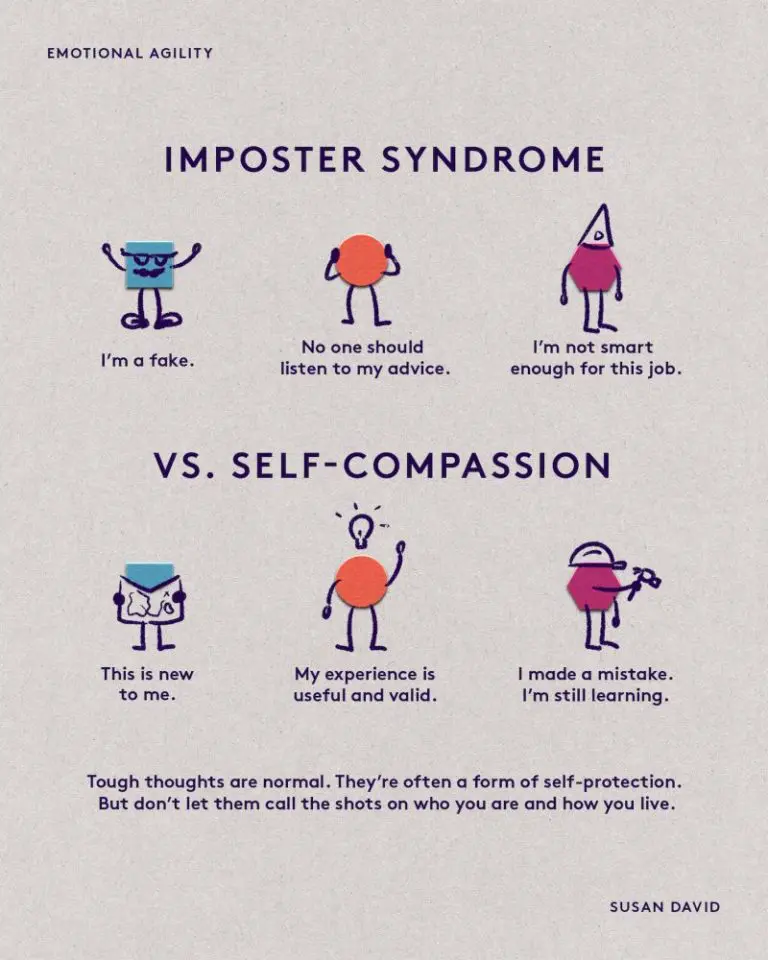
What can you do about it?
What is within your control that can build your self-confidence and help you stop feeling like an impostor?
Name it and talk about it. The first step with most challenges is accepting that they exist. Talk with a coach, a friend, a trusted advisor, or journal about how you feel. Then explore why you feel this way. What are the contributing factors?
Stay green and growing. “If you’re not green, you’re not growing” is one of my favorite expressions. When a plant turns brown, it has stopped growing. So keep nurturing the plant. Wherever you are on your journey, the goal is to be green and growing. Shift your perspective and see yourself as a beginner learning something new. You’re not a fraud; you’re growing.
Focus on the positive. ANTS are automatic negative thoughts. The antidote is to recall times you succeeded and felt proud of what you accomplished. They can be big or small, even seemingly insignificant. Doing this helps shift your mind toward evidence of what you can do.
Here’s an example from my own life. My negative thoughts sound like this: “I’m not a great writer, who wants to hear from me, and no one will buy the book I hope to finish someday.” The positive counter-thought is: “I have lived experiences worth sharing that might help others.” Writing this post is something I can be proud of, and I need to remind myself of that.